
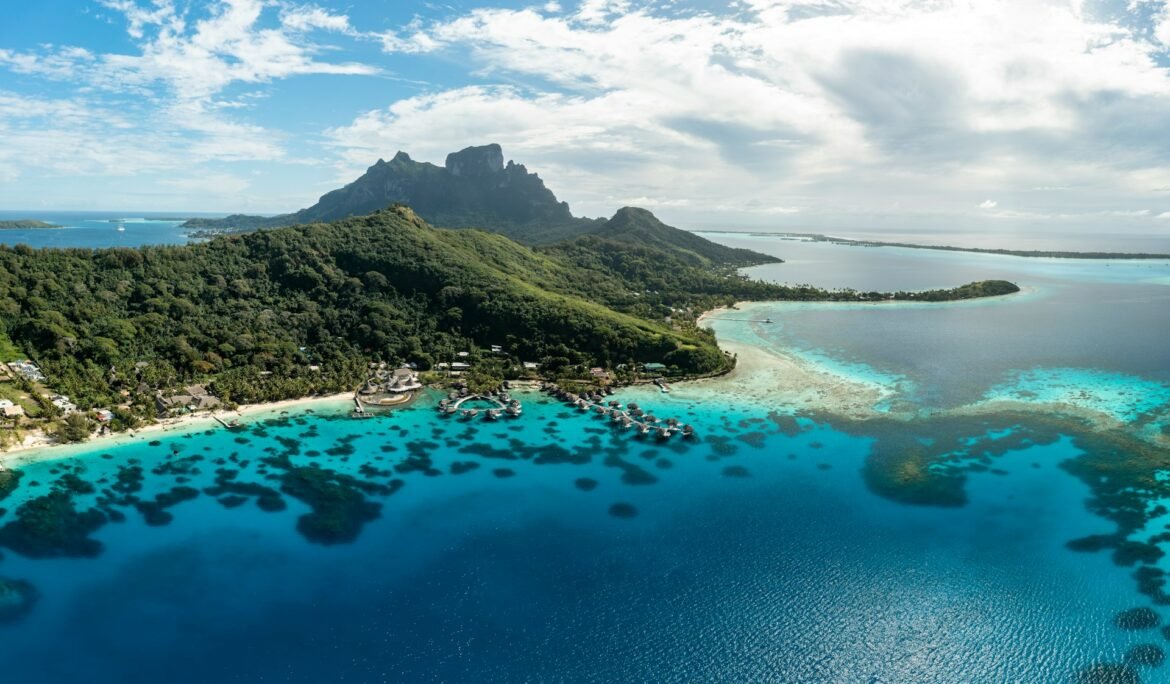
Bora Bora is best known for its iconic overwater bungalows, but the island itself offers far more than lagoon views from your deck. Covering just under 30 square kilometres, this volcanic island is defined by lush peaks, a surrounding coral reef, and a handful of small settlements and historic sites that reveal a more grounded side of French Polynesia.
Vaitape: The Heart of Local Life
Vaitape is Bora Bora’s main village and administrative centre. Life here is simple and unhurried, with ferries arriving at the quay and locals going about their daily routines.
It’s worth taking time to walk along the waterfront, browse the small market stalls, and stop at one of the roulottes (food trucks). This is the best place to try poisson cru — fresh raw tuna marinated in lime juice and coconut milk — often considered the national dish of French Polynesia. A cold Hinano beer completes the experience.
Exploring the Island by ATV
One of the most popular ways to see beyond the lagoon is an ATV tour around the island’s interior. These guided excursions travel through tropical vegetation, old plantation roads, and historic sites left from the Second World War.
Along the way, you’ll reach elevated viewpoints overlooking the lagoon, where the contrast between deep ocean blue, turquoise shallows, and the ring of motus becomes especially striking. Most resorts can arrange these tours directly.
Hiking Mount Pahia
For those who enjoy hiking, Mount Pahia offers one of the best viewpoints in Bora Bora. The trail is steep and often muddy, so a local guide is strongly recommended.
Unlike Mount Otemanu, which is generally considered inaccessible without technical climbing experience, Mount Pahia can be hiked to its summit by experienced trekkers. The reward is a panoramic view over the lagoon and neighbouring islands that feels completely removed from the resort areas below.
World War II on Bora Bora
During World War II, Bora Bora was chosen as a supply and refuelling base for the United States under Operation Bobcat, established shortly after the attack on Pearl Harbor. Although it never saw combat, the island played a logistical role in Allied operations across the Pacific.
Several coastal defence guns were installed around the island and remain in place today. Now rusted and partially reclaimed by vegetation, they are quiet reminders of this period in history. Many ATV tours include stops at these sites, often paired with sweeping viewpoints over the lagoon.
The Lagoon and Surrounding Motus
Motu Tapu
Motu Tapu is one of the most photographed islets in Bora Bora, known for its white sand beaches and turquoise water. While it is privately owned, it is regularly included in lagoon excursions and private boat charters, often as a picnic or photo stop rather than a fully independent visit.
Lagoon Excursions
Lagoon tours are among the highlights of any stay in Bora Bora. These typically include snorkelling in coral gardens, encounters with blacktip reef sharks and stingrays in shallow sandbanks, and stops at various motus around the main island.
They are widely available through resorts and local operators based in Vaitape.
Scuba Diving the Outer Reef
Beyond the lagoon, Bora Bora’s outer reef offers excellent diving conditions. Certified divers may encounter grey reef sharks, lemon sharks, eagle rays, and turtles, along with healthy coral formations. Local dive centres also offer introductory dives for beginners.
Culture and Traditions in French Polynesia
Heiva i Tahiti (July)
If you are visiting in July, you may experience Heiva i Tahiti, the region’s most important cultural festival. While the largest celebrations take place in Papeete on Tahiti, smaller events are held across the islands, including Bora Bora.
These festivities include traditional dance competitions, drumming, canoe racing, and cultural demonstrations. The performances are deeply rooted in Polynesian identity and are a highlight of the island’s cultural calendar.
Polynesian Navigation Heritage
Polynesian settlers arrived in Bora Bora roughly a thousand years ago, part of one of the most remarkable migration stories in human history. Navigating vast stretches of open ocean, they used stars, wave patterns, wind, and wildlife to travel between islands.
This heritage remains present today in outrigger canoe racing (va’a), a sport and tradition that continues across French Polynesia.
The Tiare Tahiti Flower
The fragrant Tiare Tahiti is the national flower of French Polynesia and is used to produce monoï oil. It is also part of everyday cultural expression.
Traditionally, wearing the flower behind the right ear indicates someone is single, while wearing it behind the left ear indicates they are in a relationship. Visitors often receive a flower lei upon arrival, and its scent becomes closely associated with time spent in the islands.
Food and Local Flavours
Food in Bora Bora is centred around fresh seafood and tropical produce. Poisson cru is the most iconic dish, but grilled mahi-mahi, tuna, and reef fish are also widely served.
Traditional staples include ’uru (breadfruit), taro, sweet potato, and tropical fruits such as papaya, mango, and coconut. Many restaurants also use vanilla sourced from nearby Taha’a, which is known as the vanilla island of French Polynesia.
Seeing Bora Bora from Above
A helicopter flight offers a different perspective on the island’s geography. From the air, the volcanic peaks, circular lagoon, coral reef, and surrounding motus form a striking natural composition.
Flights are typically short but highly scenic and can be arranged through most hotels or local tour providers.
Read about the best Overwater Villas & Bungalows in French Polynesia
Honeymoon on Water is the world’s leading editorial directory of luxury overwater villas and bungalows for honeymoon couples.